Last month, folk-rock band Dawes opened for music legend Bob Dylan at Raleigh’s Red Hat Amphitheater. For the L.A.-based quartet, this was an opportunity to expose NC to their music and hopefully gain new listeners. Captivating Dylan fans is never a simple task, but after a strong set of old and new songs, front man Taylor Goldsmith and crew left the audience wanting more.
As with many bands today, Dawes continues to straddle the fence of stardom, getting just enough airplay to be recognized, but not completely breaking free of the “almost famous” label. The band’s first two albums were moderately successful, and laid down the foundation for their overall sound–a throwback style reminiscent of Jackson Browne and 1970’s California folk-rock. Everything sounded great, but the band members realized they needed something different for their next album–a change of scenery.
So, they embarked on a cross-country journey to discover a fresher sound. The foursome packed up shop in L.A. and headed east to Asheville’s Echo Mountain Recording Studio to lay down their third studio album, “Stories Don’t End.” Their time in the Blue Ridge Mountains resulted in a well-crafted album that maintains all of the good components of previous albums—Goldsmith’s storytelling and refined, melancholy voice backed by crisp, minimal instrumentation—while taking risks on some new material. Throughout the 12-track album, there are obvious moments where Dawes’ sound meanders in a new direction—most succeed, while others fall short of the mark.
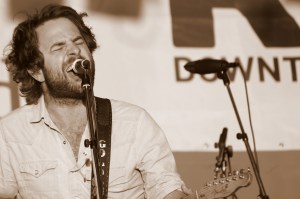
Taylor Goldsmith of Dawes
On the album, Goldsmith proves himself once again as an insightful and highly-detailed songwriter—tackling themes of doubt, reflection, love, death and failure. Goldsmith’s lyrics tell stories of down-trodden, self-doubting characters with a hint of guarded optimism. His raw and honest poetic offerings feel like snapshots of his own life experiences, making the album feel authentic and very personal.
Album opener, “Just Beneath the Surface,” sets a punchy cadence with a distant freight train drum beat and lyrics of skeletons in closets and hidden impressions. Goldsmith’s verses are simple but sharp, coercing listeners to probe for deeper meaning in everyday routines. The bass-heavy, “From a Window Seat,” gives a play-by-play of a day in the life of a traveling songwriter, filled with conjecture and imagination.
Griffin Goldsmith
The album pumps the breaks on “Just My Luck” and “Something in Common,” both stories of characters attempting to cope with the intersection of expectation and reality. “Someone Will” is the anthem for every guy who’s every fallen for his best girl friend, while “Most People” is the anthem for every girl who believes she’s alone in her depression. Hence, there is something for everyone.
“Hey Lover,” which was written by Dawes’ pal Blake Mills, offers a playful break with slapstick lyrics, but feels out of place between more sobering tracks. Goldsmith thankfully returns to his own songwriting with “Bear Witness,” a tale of an elderly man sharing insights with his child before passing on. The title track, “Stories Don’t End” is a twist on a waltz with Goldsmith’s voice dancing over lounge-worthy piano runs. The album ends with a beautiful, tender reprise of “Just Beneath the Surface”—a perfect chapter to close the collection—with Goldsmith’s vocals fresh and in focus, and the band backing him into the final measures.
Like a wound left open for the world to see, “Stories Don’t End” reveals emotions that are sure to make people stop and take notice. It is another excellent installation in the band’s anthology that will be praised by the astute listener. While it is clear that Dawes is evolving, this is a band that is not willing to sacrifice foundation for fame. And, if Dylan sees something special in these guys, perhaps the world should, too.
Halfway through the second full-day of MerleFest, 200 lucky festival goers nestled eagerly into their seats in Mayes Pit-Cohn Auditorium at Wilkes Community College. Some arrived early to claim front row seats, while others waited in line, hopeful to be let in before the room hit full capacity. The Avett Brothers, Scott and Seth Avett and Bob Crawford, were whisked in through a side door and waited patiently in the wings for their introduction. Proud parents, Jim and Susie Avett filed in backstage, and watched as their sons took the stage before a roar of applauds.
For those who were in attendance, this was a chance to ask the brothers any and everything about their songwriting process and style, song themes, production, and evolution. The 45-minute session was filled with copious bouts of laughter, candid banter, and small but noticeable moments of brotherly love. While the workshop focused primarily on songwriting, the band managed to squeeze in 3 acoustic songs, one of which was completely new. This poignant ballad had the audience hanging on each and every lyric that dripped from Seth’s lips, and at the end brought the auditorium to its feet. It was a very special experience that those 200 people will cherish for a very long time. For those who were not fortunate to be there in person, here is the transcript:
(The Avett Brothers were introduced and came out on stage, Seth and Scott with their Martin and Gibson acoustic guitars, respectively, and Bob with his stand-up bass)
Scott: Thank you so much y’all.
Seth: So I thought we were attending a songwriter’s workshop not putting one on. What’s going on? (laughter)
Scott: Ha, come to the festival. We’d like for you to do this workshop before you play. We’re going to start by just playing a song. We would like to talk to everyone as much as we can, because we’ve been to several of these workshops and some of them that we’ve been to, we wish we could have heard more questions. But we are going to start with a song just to warm up with (strumming)…that falls in the singer/songwriter category.
Seth: So, does anyone have a question?
Scott: Yeah, let’s hear it!
Audience member 1: First of all thank you guys for making music. You guys are awesome. Secondly, what was your inspiration for making the song “January Wedding?” That’s my wife and my wedding song, so I just wanted to know what your inspiration was.
Seth: Um, well, outside of the obvious – a wedding in January (laughter). No, that was one that I just wrote…I hate that you are asking a question about one of the more mysterious ones as far as the source, well the theme is pretty obvious. As far as the writing of it, it was one of the rare ones that I wrote very quickly–10 minutes top to bottom. That doesn’t often happen. I’m more of a writer that comes up with an idea, and then studies it and works on it for weeks or months or years.
Scott: That’s for sure (laughter).
Seth: Yeah, I’m kind of studious about it. I’ll set up, you know, the coffee and the notebooks and the computer and just work and work on it. But yeah, just a real life event like most of our songs I guess, are things that we’ve experienced or want to experience, or have learned from or want to learn from.
Scott: Pertaining to that subject, we are pretty guilty of writing straight from the heart sort of, and exploiting our personal lives quite a bit. I mean that is our subject matter most of the time. And [“January Wedding”] would fall into that category. I don’t know anything about the writing process of that song. That’s one that Seth brought. It was in Seth and came out of him. In fact I didn’t even know until now that it was written quickly.
Seth: It took a lot longer to record it.
Scott: But yeah it certainly falls in the category, just like “Murder in the City” of songs that are scary to put out there. For one, they could be embarrassing and for two they could be exploiting someone we love quite a bit, or an emotion that you had or an emotion that someone else had.
Audience member 2: There are so many songs about pretty girls, how do your wives deal with that?
Scott: We just tell them that they are not real (laughter).
Seth: I like that there’s an assumption that our wives listen to our music (laughter).
Scott: I am very thankful to live with a woman who has no idea half the time what I am putting out there. The audience usually knows quicker than they do. Luckily they don’t care.
Audience member 3: How has your process changed from your earlier days? How has it evolved to where now you are recording with Rick Rubin. I read a story early on that as a kid you were writing a song about a chicken (laughter). So how has it changed form then, to your early stuff, to now with Rick Rubin.
Seth: Despite my brother mocking me, I did attempt to write a song about chickens. Scott shot them down and it took me quite a long time to get over that (laughter). Still working on it. How has it changed? Scott and I first started writing songs by…I guess our first real attempts, we were putting them on cassette tapes and mailing them to each other. So that’s changed. We don’t do that anymore. We do some version of that. I think that maybe the process hasn’t changed as much in the writing process, perhaps in the revision process. Perhaps when we get into the studio and we start to realize that stuff works or not works and trying to be more open to letting it change. And also, Scott mentioned a vulnerability in songwriting. It’s sort of realizing when that’s appropriate and when it’s not. We put more emphasis on that now, and try to take ourselves out of the equation, and knowing that we are trying to make something that’s gonna stay even after we’re gone. So we can take some of the embarrassment factor out of it. I don’t think we thought about that as much, early on.
Scott: Personally I don’t sit down and write in sessions until there’s something that we’re working for like a recording or group of demos that have sort of surfaced. I much more into just letting the things come to me. I have this junk pile and I saw Chris [inaudible] talk about it once and it’s true to me. I notice that when Seth and I come together, which we do–we did just a couple of weeks ago–we usually meet at his kitchen table and Seth will have all of these things laid out all perfectly, like recording devices, his computer, stack of notebooks and they are all itinerary.
Seth: 90 degree angles.
Scott: Yeah, then I have napkins and stacks of junk with words on them, written upside down and backwards, and I just plop it down. I’ll piece together a collage of words that makes a song over a long period of time. So my process –and I think we can complement each other on how this process has changed, where I don’t force things as much as I once did. And, that may mean less songs, but I think that’s okay and that’s something we have learned along the way—that less songs is maybe better, putting more emphasis on fewer songs. But there’s not a lack of them still. We’ve got a lot of them. We’ve played one that kind of pertains to–in “Father’s First Spring”–it’s very pertaining to a song that’s written very fast and a song that certainly was scary to put out there, regarding exploiting the family, and family experiences (warming up instruments). This song was written traveling on the bus. I thought that childbirth would bring this wave of songs in my life that would just be unstoppable and it did not do that. It was more of a slow…well there was no time to write songs once the kid came along. This is the first song that came that I remember. This is “Father’s First Spring”.
(The band performed “Father’s First Spring”)
Scott Avett
Audience member 4: What song did you guys have the most fun performing or writing?
Scott: (pause) Of all time? (laughter). The consistent answer to a question kind of like that one is that it seems that newer discoveries–as far as songs are concerned, which sometimes can be old songs and sometimes with the songs that were just written–we kind of pull something back and it has a new life with the instrumentation or a new approach, so that song gets pushed to the front, and it’s really enjoyable to play for this moment or time or shows. Then you will see us playing that song more at shows and whatnot. That changes, of course, in the recording studio as well. I think lately, for me personally–well it’s somebody else’s song–there’s a Buck Owens song that we’ve been doing and it’s a lot of fun to play. It’s just a song that we discovered. Nobody had ever heard of it until Seth heard it on his record. But, that we’ve written, lately we’ve been doing this medley thing that we did on TV not long ago with “Kick Drum Heart” and “Geraldine”. It’s very rock and roll but it’s a lot of fun, and it can just set off and take flight. I’ve had a lot of fun with that.
Seth: Yeah. I just want to point out something that I enjoy, was that she asked the question and Scott’s like, “Well the answer to a question that is very similar to that question is…” (laughter). I’m seeing Scott’s sort of very easy transition into politics when someone asks a question and [he says] “Well you know what let me answer a different one.” (laughter).
Scott: I know what’s going to happen. I’m going to be the writer for Bob’s speeches.
Seth: That’s right.
Scott: He’s the perfect politician.
Seth: Classic good looks
(cheers from audience for Bob)
Scott and Bob
Audience member 5: This is like the classic songwriting question. What comes first for you guys, the melody or the lyrics?
Seth: I’ll answer this question for Scott (laughter). Scott – while we are highlighting differences between he and I – Scott will sometimes come to me with this idea for a song and be like, “Hey check out this idea for a song.” He’ll play like 3 or 4 minutes long and then he’ll get done and I will be like, “Well you know, it’s an interesting idea, I don’t know about the melodies.” [Scott would say] “Oh don’t worry about the melodies.” And I’m like, “Okay, well maybe we can change a chord.” [Scott would say] “Oh don’t worry about the chords either.” (laughter). That seems pretty consistent with Scott. I think with me it’s kind of either way. It’s just always changing. We feel like the really valuable thing to do with songwriting is to really fight tooth and nail against formula, so try not to get into some way you do it all of the time, and you’ll be in better shape. We’re in better shape when we do that.
Audience member 6: You guys went from playing on street corners and over the years playing and selling out theaters. You talked about the recording process earlier. As far as musical structure and musical elements, how do you think you guys have evolved over the years?
Scott: Once again I can really only speak for myself because Seth always had an awareness of melody and singing much more than me. For me, awareness of key and pitch and singing has been something that I know for the first 4 or 5 years of our existence I didn’t pay any attention to at all. All I wanted to do it to get on stage and move and make an impact – surprise people, or scare people, or excite people, or make people angry or happy or whatever. I just knew that I wanted to shake things up. But for development, I think this goes along for both of us, we’ve become much more aware of wanting to make something that is great in our eyes–in the 3 of ours’ eyes. That will never be reached. It’s kind of like saying, “Well one day I’d like to be perfect.” Of course that will never be reached but we will always try to strive for it. So, there’s a natural progression of refinement in our recordings that we have to this day and continuing have been the captains of. We’ve been very lucky to be the captains of, because we’ve always been allowed to cover our business trail with the art leading. You know, the art has always led the business. So we’ve always got to say, “This is what we want to do with the recording. This is how we want it to work. This is what we are aiming for.” And then people get in line and help us. The answer I’m getting to is just that I hope to refine what it is that we do. That doesn’t necessarily mean cleaner and more polished because we have quite an interest in albums like “Tonight’s the Night” by Neil Young where you have like a true live experience that happens one time and one time only. We’re just searching for great art, or no not searching. We’re trying to make ourselves available for it to find us.
Audience member 7: Are there any songwriters that influence your songwriting, such as John Prine and Bob Dylan?
Scott: Both of those for sure. Townes Van Zandt is huge for me, starting in like 2007. I’d actually avoided Townes Van Zandt because I didn’t like his name (laughter). I have no idea what that even means. I mean I have no idea – total ignorance. But, when I grabbed on and understood the hopeful darkness that he sort of brought with his lyrics, I felt very akin to it.
Seth: I know Bob, I and Scott all would say one is Tom Waits. He’s someone who has no interest in genre or sticking to any genre, which I think is really important for someone who wants to create something and find their original voice, even if their original voice is a crazy circus master, or whatever. Really, he’s someone who could have just skated along as, in the early days, as “Oh it’s the next Bob Dylan, but on piano.” There were a lot of “here’s the next Bob Dylan” throughout the years and decades, but he could have kept on making really quality piano music with a trio or whatever, but it’s really nice how when you think he’s going to zig he zags. He always seemed pretty healthy in his older tunes, and that’s what we’re going for.
Audience member 8: I kind of have a two-part question. One, if you guys ever get stuck or have dry spells do you have things that you do to re-inspire yourselves? And also as you’ve seen your audience grow and become a bigger operation, has that influenced knowing that more people are listening and waiting for bigger music. Does that influence your songwriting?
Seth: The second part of that. You can’t completely ignore it when you know that you are going to record something and if you share it, there’s at least a good chance that hundreds of thousands of people are going to hear it. And while there are really positive sides of that, you could just start psyching yourself out. So I think we’ve worked hard to keep each other grounded, and to find the balance between staying true with it and staying genuine in what we what to do and what really matters. And also not making it seem like it’s more important because more people will hear it. You know initially I was thinking that the f-word was going to be in this song, but maybe not so much anymore.
Scott: The song “Down with the Shine” initially had the f-word in the chorus.
Seth: It was like, this is punk rock–this is good.
Scott: It just was.
Seth: It was like, “Is this exactly what you want to say?” I was like, “Well I don’t know if that’s exactly what we want to say.” (laughter)
Seth: What was the first part of the question?
Seth and Scott Avett
Audience member 8: If you ever get stuck or have dry spells do you have anything to re-inspire yourself?
Scott: I just walk away from it whenever I’m stuck, because the more I convince myself that I am stuck, then I’m stuck. To me there’s a really…I do this with shows sometime. I say, “I don’t care about this,” and just throw it away. Sometimes I’ll do it with a verse. Then I can go out, and I can go relax and it just happens that that’s just the best way. To put all of this importance on one song, you know. I have, well I guess we have, but I have certainly thousands of ideas that are unfinished that if I really let myself think about it too much, it’s overwhelming and daunting. But, things just keep moving forward, so I just let it go. Throw it away. I’m into that. I have this definition I came up with, well not really a definition, no. Seth and I were talking about running. He ran this relay thing a couple of weeks ago. We were talking about it and I said, “Well you know all that matters is that you win, right?” (laughter) He said, “Oh yeah.” We were having a laugh about that. And then we realized the definition of winning, and it got me really thinking about well, no matter who wins the race, whoever is at the pub at the end of the night enjoying camaraderie after this long day of running and you know, exhausting endeavors, whoever is really having the most fun wins. It doesn’t matter who came across the finish line first, or who did it the best. That person will still be jealous of seeing the guy that’s like, “I lost but I’m still having fun.” (laughter) So you know if I hit like a bad note or something, I have to remember that if I am having fun, if I can define fun, including as many people in a good way as I possibly can and have as much of it as I can, then what I’m doing being stuck or not stuck kind of starts to fall away.
Seth: I try to zone in on the same thing when Scott hits a bad note (laughter).
Scott: And Seth will remind me every time (laughter). He likes to do this joke where he comes off the bus and sees whatever nice fella is going to help us at the club or concert or whatever. And, Seth comes over and says, “Listen these guys on this bus have been riding my coattails since day one.”
Seth: I do like to say that (laughter).
Bob: Can I just say one thing here? I just want to say a quick little story. There was a song—we were about to play a festival—and we were in the trailer 5 minutes before we were going on, and there was a very old song that we’ve been playing for 10 years. We were practicing, the 3 of us, and we hit a point and Seth said to Scott, “What chord are you playing?” [Scott said] “Well, I’m playing a G.” [Seth said] “Well you are supposed to be playing an E.” [Scott said] “I’ve been playing this G for 10 years!” (laughter)
Scott: I said, “Why is that important?”
Bob: I don’t know if the moral is that it’s never too late to be better. If it’s Seth it’s: “never too late to be better.” If it’s Scott it’s: “Man I’ve been playing this chord for 10 years!”
Scott: Here’s the problem, the G in my mind works simultaneously with the move when I hit the drum, and it had to stay there because if I was going to make the move on stage. [I should just] deaden all of the chords and just do that (does a cool move).
Seth: Then you could keep the most important part, which is the rock and roll move (laughter)! The great thing about when that happens, and that will happen occasionally, where I am like, “How can I say this to Scott? Scott listen, you are just hitting the wrong chord. I don’t mean for it to be an insult.” If it’s early in the tour Scott’s like, “Oh yeah, my bad. I’ll play the right chord.” But if we are like 2 months in and we are all just ragged, and I’ll be like, “Scott, can you hit the right chord?” and we are just…
Scott: Then later that day I say, “Seth I’m thinking about quittin’.” (laughter)
Seth: Just put like “Quittin’ Hard” on the (inaudible)
Scott: I’m in my pajamas…toothpaste in my beard (laughter).
Audience member 9: How has working with Rick Rubin influenced your process?
Seth: Well there are a few answers for that. He helped us calm down a bit in the studio. Earlier–this question about playing on street corners and getting in the studio, and actually getting to spend significant time in the studio–um playing on the street corner, volume was more important than anything was, you know. So, we worked much more on turning our voices into megaphones rather than having good pitch or especially good rhythm. Working with Rick, it was good because his work speaks for itself, so our ears were open. We’ve been very guilty of just not hearing a lot. Early on Bob would try to help us get some things wrangled in and we were just like, “Nahhhh, we’re good to go. Let’s go on and play right now.” And you know we would. And in the process, me and Scott and Bob over 8 years that we were a band before we met Rick and got in the studio to make “I and Love and You”, Bob admits this but I hadn’t really, that our tempo was all over the place. We stayed together as one voice but we would fly and slow down and fly and slow down, and we were the only 3 that could understand why that was happening. It was just because of hundreds and hundreds of shows. So, working with Rick on a technical aspect, he was really good about saying, “Let’s just tear this down for a second and rebuild it from ground up. Not change the song but let’s just find out what’s happening and why this part feels like, not a disappointment, but just a drop off. It’s not the part. The part’s great, it’s good, but we are slowing down for some reason.” That works on a street corner, but we started having trouble with that working in a room where we really want to hear a song over and over and over and over and over and over.
Scott: There are 3 things that I notice he does as well. I think our lives kind of came together at the right time. I think we all believe that there’s a natural way that a song’s supposed to be and there’s probably several ways that it should be, but we believe it will settle in to a natural –it’s not really in our control. We just know when we hear it. Now there’s probably more than one way and at some point you can pick that they are all right, but you have to get it to that general space where nature sort of says, “This work of art has to be like this, more or less.”
Seth: Yeah, because there’s way more ways to over complicate.
Scott: With that, Rick working in hip-hop, he got good at inventorying parts. He’ll listen to a song once and say, “Well on the second pre-chorus,” which he names it pre-chorus and I’m the one who’s always like, “Why’s it gotta be called a chorus or pre-chorus, let’s just not call it anything. What’s it matter?” But, he’ll inventory everything after one listen and be able to name these parts and where thing mood-wise happen or note-wise or key-wise happen, and then you can all talk about it and play around. Where the hip-hop part comes in is that he can actually visualize this piece and then switch it around, and play with it in the studio like you would with digital parts. We don’t really deal with digital parts. We are pretty dead set on trying to…
Seth: Actually play the song.
Scott: Yeah, um and the third part I forgot.
Audience member 10: Relating to the last song you guys played. How does the songwriting process and the touring schedule work together. Because I imagine it would be pretty frustrating to be inspired when you are seeing the highway every day. So, do you write more songs back home on break or on the road?
Scott: It is both. It’s gotten less to be both as it used to be. It used to be, you could kind of see the world more when you are in a van, right? We travel on a bus now more, or on an airplane. So it’s gotten to be where you are sitting in the coach section of the plane and you really aren’t getting a whole lot of inspiration. Although, your mind can go a lot of places…I don’t mean to drift. We have compartmentalized it a little more at home now than we used to. I think the more we travel, what happens is the more you travel the more you have to travel, and the more you see the more you discover these new words and they have new meanings with new experiences. So like when you are at the Cliffs of Dover and you are like, “Oh my gosh the Cliffs of Dover, what a great line,” you know. And what’s happening right at the Cliffs of Dover is that you are on this ferry that’s got swells of 10 ft and you’re looking down one window and seeing the channel and looking out the other in the sky, and it’s like, so what IS happening right now? So in that regard, being on the road offers all of these new words and new discoveries that have…I always compare it to gold to cash. You know, you have cash. The cash is the song, but it’s gotta have the gold to back it up, which has to be the experience or the belief. You have to actually believe it, because when you try to continue on in your life, I’ve learned and we’ve learned that if [we] try to continue to play songs that we don’t really believe, they just disappear. They’re not important. That’s why so many of these old-time songs have lived so long. They have so many layers of belief and history in them, from so many people, that they are established like a brick foundation, you know–a stone foundation. We should take one more and then you should play that new song.
Seth: Yes.
Scott: We’ll just watch you (laughter). Let’s switch it up and go right here.
Seth Avett
Audience member 11: Thank you very much for the joy you’ve given this 40-year-old man…
Scott: Your beard looks great (laughter)…You are out of the service now.
Audience member 11: Yes I am! Thank you very much. You’ve provided the soundtrack for our wedding, thank you. But my question is, let’s go back to high school age, Seth, Scott, and Bob. What were you guys running to the store to buy. I know we talked about Fugazi and all of that stuff, but what other stuff were you listening to 20+ years ago?
Bob: Bruce Springsteen, The Replacements, and Tom Waits.
Scott: I’ve said this over and over, and I’ve started to not want to say it because I am afraid it will get me in trouble one day, but I just worshiped Mike Patton from Faith No More–Mr. Bungle and Faith No More–and anything that he was doing. Then all of the grunge stuff was happening, so Alice in Chains and Soundgarden. Which, by the way, I feel like – Blind Melon – I feel like they were all kind of precursors to what I guess some people call the neo-folk thing, which I think has been going on forever. But, I think there was a lot of acoustic rock going on within Nirvana, within Soundgarden, within Alice in Chains. I think “Jar of Flies” was an amazing acoustic record. But anyway, all of that stuff in high school, that’s what it consisted of…Red Hot Chili Peppers.
Seth: Nirvana obviously, um the Deftones, and Doc Watson—a lot of Doc Watson.
Scott: So this is interesting, we got on the bus this morning on the way up and we talked a little bit about not wanting to play too much during the workshop, because we wanted to be able to talk, because we love to talk (laughter).
Seth: We…WE love to talk (laughter).
Scott: So, um, every once in a while, I would give Seth some type of devisal situation, and he will go through lists of his if I haven’t, and it’s typical for me to forget them or just remove myself from them. Seth found kind of this list of them that he started pulling from on his own, so this is an indicator of sort of our process—one part of our process. So, he kind of brought back this series of songs that he’s basically taken ownership of, but we both wrote them. It’s kind of interesting. [To Seth] Um, I don’t really think I should try to play, unless I can…
Seth: Um, okay.
Scott: Well, I mean I will try…
Seth: Yeah, just try.
Scott: Okay, I’ll just do a couple of chords. So this is one of those songs from this new list that we have that we are just kind of watching the songs happen.
(Seth performed a new untitled song. Per the band’s request, audio and video of all unreleased songs should not be posted on the internet)
As previously mentioned, the session ended with a standing ovation as the band smiled, thanked the audience, and promptly left the auditorium. The following day, The Avett Brothers closed out the festival with a raucous and rainy set on the Watson Stage that left the waterlogged audience begging for more, despite the day’s incessant drizzle. Rain or shine, these men always bring their best to the stage, and this year’s MerleFest performances were no different.
Here was an especially moving moment from their Watson stage set, where Scott and cellist Joe Kwon performed “Am I Born to Die”.
MerleFest, April 25-28, 2013@ Wilkes Community College in Wilkesboro NC
MerleFest is a family friendly music festival that was founded in 1988 in memory of Eddy Merle Watson — son of American music legend Doc Watson. For over 25 years, the festival has maintained its original purpose–to raise funds for Wilkes Community College while celebrating “traditional plus” music. Today, MerleFest is considered one of the top music festivals in the country, drawing more than 75,000 festival goers and some of the biggest names in traditional bluegrass, country, Americana, folk, rock and more. This year’s festival will feature over 90 musicians on 14 stages over the course of four days, so festival goers are encouraged to download the MerleFest app before they arrive to ensure the ultimate festival experience!
In true MerleFest fashion, festival organizers have gone above and beyond to congregate the best of the best at WCC. This year’s lineup features rising musicians like The Black Lillies, Pokey LaFarge, and Delta Rae alongside industry vets like Jim Lauderdale, Jerry Douglas, and headliners The Charlie Daniels Band, Nitty Gritty Dirt Band, and Warren Haynes & Gov’t Mule. Additionally, local favorites, The Avett Brothers, have signed-on to closeout the festival on Sunday afternoon, but not before their talented father, Jim Avett, takes the Creekside Stage to perform a special family gospel set. In addition to this year’s stacked lineup, Sam Bush will host an all-star tribute jam on Saturday night to honor the life and music of the festival’s founding father Doc Watson, who sadly passed away last year.
While it is true that MerleFest mainly involves relaxing and enjoying the company of old and new friends while taking in amazing live performances, there are also several opportunities for fans to get involved and play some music themselves. Musically inclined fans can join others to pick, sing, and learn at Jam Camp, Pickin’ Place, and The Songwriters’ Coffeehouse. Young festival goers may enjoy spending some time in the Little Pickers Family Area, while fans of all ages can venture out into the WCC campus woods for a Nature Walk. MerleFest also features a series of contests for musicians and songwriters, including The Merle Watson Bluegrass Banjo Championship, The Doc Watson Guitar Championship, and The Chris Austin Songwriting Contest. The twelve finalists for the CASC will perform on the Austin Stage on Friday, April 26th at 2:00 PM, and will be judged by a panel of music industry professionals, including Jim Lauderdale. The first place winner will receive a performance slot on the Cabin Stage that evening. All proceeds from the CASC benefit the WCC Chris Austin Memorial Scholarship. And, last but certainly not least is the Saturday night Midnight Jam — a fun and often rowdy festival tradition!
If you are looking for a music festival to kick off the spring season, MerleFest is for you! Load up your car, head out to Wilkesboro, set up a tent at one of the many surrounding campsites, and be prepared to have your mind blown by some of the music industry’s best. Multi- and single-day tickets are still available. For more information about MerleFest, musicians, and festival events, please visit www.merlefest.org.
In 1953, President Dwight D. Eisenhower delivered a speech to the United Nations General Assembly titled “Atoms for Peace” — a well calculated attempt to ease a fearful nation and world in the wake of a hasty nuclear arms race between the United States and Soviet Union. It wasn’t until sixty years later, that the speech’s title would reemerge, this time as the band name for Radiohead lead singer Thom Yorke’s side project. Yorke adopted Ike’s speech title just before dropping the band’s debut album, “Amok,” a nine-track electronic bomb of synthesized and acoustic rhythms enriched by Yorke’s signature voice.
A few years prior to the recording of “Amok,” Yorke called upon Red Hot Chili Peppers’ bassist Flea, longtime Radiohead producer Nigel Godrich, drummer Joey Waronker of Beck and R.E.M fame and Brazilian percussionist Mauro Refosco to help rework music from his solo album, “The Eraser,” for live performances. What started as a transient collaboration of powerhouse musicians for the stage, transitioned formally into Atoms for Peace and the idea for “Amok” was born. While “Amok” could very well be considered Yorke’s follow-up to “The Eraser,” its energy is built on a melding of live percussion elements with generated beats that Yorke admittedly could not have accomplished independently.
“Amok” is a fitting album title in that as a whole it possesses a constant state of musical frenzy, shifting back and forth between organic and electronic to the point of organized chaos. The intricate layering of beats comes off quite effortlessly when paired with Yorke’s etheric vocals. Each track provides listeners with a unique cochlear experience that should be fully appreciated through headphones, so as not to miss a beat or lyric. Every element deserves the listener’s attention.
Individually, each track offers a nuance of sound, while together tracks maintain a cohesive flow throughout the album. For this reason, it is difficult to pick out the obvious frontrunners. The album’s opener, “Before Your Very Eyes…,” feels like a journey of hasty locomotive beats fit for The Darjeeling Limited, complete with distant sounds from the bar car of ice cubes being dropped into empty glasses. “Default” and “Dropped” offer a synthesized video arcade vibe with different tempos. “Ingenue’s” unrelenting rhythmic raindrop beat balances the virginal fantasy world that Yorke’s lyrics create, while “Useless” enlists a hardened industrial approach with tight drumming, likely influenced by Afrobeat legend Fela Kuti.
“Stuck Together Pieces” is anchored by Flea’s bass lines, while “Judge, Jury And Executioner” is all about Yorke’s ghostly background vocals and claps. “Reverse Running” is the one track on the album that relies least on the laptop and more on the live performances by the band’s members, which is a nice departure for the ears. The album ends with the title track, “Amok,” which keeps the beats consistent and uncomplicated, while progressively layering vocals over each other.
Throughout “Amok,” lyrics billow weightlessly over explosive beats, often getting lost in translation — perhaps deliberately. However, with Yorke being one of the most over analyzed musicians of the past few decades, it seems unlikely that he would carelessly string lyrics together devoid of thought. Themes of love, despair, mortality and self-deprecation emerge at selective moments, but overall the lyrics are not the driving force of this album — the crown belongs to the beats. Whether a listener wants to analyze every intricacy or just let the music take over, this album provides an escape from reality — a place to get lost for 45 minutes — and for many music lovers that is all that is needed.
In 1986, hip-hop legends Eric B & Rakim recorded their first track, and manifested into NYC’s most beloved DJ/MC duo overnight. Eric B supplied the beats, while Rakim displayed his metaphoric lyrical mastery with ease. Two years later, NYC welcomed a fresh set of lungs and wide eyes to its gritty streets — a baby boy aptly named after the city’s poetic genius himself, Rakim — destined to break free of the concrete jungle confines one day.
Rakim Mayers, aka A$AP Rocky, grew up wanting — dreaming — for more. As a teenager, he watched his drug-selling father get sent to jail, only to have his older brother murdered a year later. In 2007, he fell into a band of brothers known as the A$AP Mob, from which he was given his A$AP Rocky moniker. This crew became his support system — a rap project that allowed Rocky to perfect his craft with high hopes of returning hip-hop honors back to NYC.
In 2011, Rocky quickly gained attention for his eclectic style — both in delivery and fashion. In the blink of an eye, he was signed to a multimillion-dollar deal and thrown into recording his debut album, “Long.Live.A$AP.” On this album, Rocky pulls inspiration from every corner of the hip-hop nation, and blends styles into a collection of tracks that places him above the competition.
Claps of thunder open the album and set the tone, as Rocky spits the perfect storm of lyrics drenched in sex, drugs and violence — made acceptable only by the promise of eternal life in the halls of hip-hop. This theme finds a home on most tracks, which are overloaded with imagery of a luxe life, with endless supplies of money, drugs and women. While Rocky’s spectrum of story seems limited, he raps effortlessly overtop a diverse stream of beats and samples laid by some of the industry’s best producers like Hit-Boy, Clams Casino, Drake and Dangermouse.
Rocky is at home on the microphone no matter the style, which lends to the album’s success. “Goldie,” “Pain” and “Wild for the Night,” pay tribute to pitch-down style of Houston’s late DJ Screw and Memphis natives Three 6 Mafia, leaving listeners feeling like they’ve been sippin’ on the sizzurp. “Hell” features M.I.A-esque vocals with new wave reggae undertones from Santigold, while “1 Train” is a freestyle throwback to days of Wu-Tang Clan, when rap crews reigned supreme. The continuum of sound is vast, but Rocky finds his sweet spot on each track.
On the platinum single, “F***kin’ Problems,” Rocky calls on Drake, 2 Chainz and Kendrick Lamar to up the ante over a tight drum beat laced with bass drops. The ear-catching audio gains even more mass appeal with a sexed-up video reminiscent of Craig Mack’s “Flava in Ya Ear-Remix.” Rocky ends the album with “Suddenly” — a slow-motion chronicle of everyday happenings on the block from childhood struggles to present-day fame. “Suddenly” rises to the top as the best track, because it highlights Rocky’s storytelling ability. Beneath explicit lyrics like “You my brother/You my kin/F**k the color of your skin” lies an important message — Rocky is making music to bring people together.
Overall, “Long.Live.A$AP” succeeds by introducing a new wrinkle in the current era of hip-hop — one that feeds off the strengths and intricacies of collaboration. The meat of the album is sandwiched between its two best tracks, where Rocky shines as a storyteller — much like his namesake. Whether he lives on in the hip-hop history books alongside his predecessor has yet to be determined.
To learn more about A$AP Rocky, visit his website. “Long.Live.A$AP” is available in regular and deluxe versions on iTunes.
Just in time for the 55th Annual Grammy Awards, I caught up with Bob Crawford, bassist for The Avett Brothers, to talk about their new album “The Carpenter”, their first Grammy nomination, songwriting, and learning to play the fiddle, among other things:
EOAF: Congratulations on the success of “The Carpenter”. How would you describe the album?
Crawford: Mature, thoughtful, intentional, poignant, pensive. I think it’s heavy, and I think that’s where…I’ve had friends that I have had since I was 19, I’m 40 now. I’ve had them say “I don’t know about this one. It’s not your best.” I think maybe we lose some people as we go, but maybe we gain people in some ways. Maybe people come and go. It’s not 2007 anymore, and it’s not 2005. It’s a different time for us and I think you are being honest about where you are in life and that being reflected in your art and what you do and the way you do it. It’s definitely going to change.
EOAF: How do you feel about how songs from “The Carpenter” have translated live?
Crawford: Oh they are great! I think they have really translated. You know what they have done? Some of them, like “A Father’s First Spring” and “February 7”, some of these song help us slow down on stage and try to meditate on being intense and calm at the same time. It’s been a lot of fun. It’s really fun to translate something like that live. We’ve had slow songs in the past–God knows we have tons of them. There’s a controlled, an intentional controlled aspect that comes musically, like a hang-there-in-space-and-time and have that patience. I’ve always thought Neil Young did that so well with songs like “Harvest Moon”–how he could have a very intense mid-tempo. That’s tricky for a musician. It’s very hard. The inclination is to play faster, because your heart is beating faster because you are on a stage and there are people.
EOAF: Is there any song from The Carpenter that you really love to play live?
Crawford: “Live and Die” is getting really comfortable. It’s starting to feel like an old trusty. We are getting better, with the last two albums, at holding songs back before the release. We were never good at that before. We’ve gotten better at that. When you record the song, but you don’t really know them, you know your part and you know the section that you did a million times, but you don’t know it like when you are on stage and let it fall out of you. When you record the record, there’s about a year before you really start playing the songs intently and constantly, and then they take on a life of their own. So, they are coming. Some of them are still in the coming phase, but some of them have been very surprising to play, like “Life” has been fun to play and “Paul Newman [vs. the Demons]” has been fun to play. That can be really fun to play.
EOAF: You played “Life” for the first time live at The Christmas Jam in Asheville. That was exciting to see you guys added last minute to the line-up. How was that experience for you?
Crawford: It was fun! Scott [Avett] and I used to live in Asheville, and I remember a time when the Christmas Jam came around. For a couple of years we were asked to participate, but we do our New Year’s show in Asheville. So it was finally good that this year we could be a part of it. It was really great, because we hadn’t played together in about a month and a half. I mean we had practiced, but we hadn’t done a show. It was fun because I was actually really nervous, but we did great. I was like, “This is great I am nervous! This is awesome.”
EOAF: That is a great feeling, and it was also a very different crowd. The majority of the people there were sort of that jam-band crowd.
Crawford: Yeah! It was nice to get that support. I could also tell from the stage that [the audience was] really there to see String Cheese [Incident]. That made if fun. It was nice to be in a room that we’ve sold out, and played two nights there before, and for it to be a new room—for the lighting to be different and for there to be no backdrop behind us.
EOAF: “The Carpenter” was nominated for the Best Americana Album award for this year’s Grammy’s. Congratulations! Where were you when you found out?
Crawford: Thank you so much. I was at home in bed. I started getting texts saying “Congratulations” and this and that.
EOAF: How does the Grammy nomination play into your or The Avett Brothers’ definition of success?
Crawford: I think it’s always nice to be patted on the back, or nice to have someone tell you good job. Let’s face it. It’s great to get a compliment. I mean, it’s always nice, but I don’t think it’s why we do it, and it’s not even necessary for us to continue doing it—to get those kind of accolades. We’re going to keep doing what we do probably until it doesn’t seem useful anymore, until there’s no need to write songs, until we feel like we’ve plateaued, or we feel like we have nothing to say, or until people stop coming to see us live. But I think the first thing, besides a tragedy, that would hasten us not doing it would be if we had nothing to say. We always told ourselves earlier that we would stop doing it if it seemed like we plateaued—if it seemed like it wasn’t going anywhere any longer, you know. I don’t know that we are there yet. I think we hope to do it forever. Maybe there are years to take off, or we can take a break, but I hope it can still exist in the same light.
EOAF: It is great that you guys have been getting recognized more for what you are doing. In that notoriety you have been asked to play with some pretty big names over the past two years—Bob Dylan, you’ve played for Tom T. Hall, and you did the Crossroads sessions with Randy Travis. Is there anything from those specific experiences that really stands out to you?
Crawford: Well they are all really touching and exciting. Obviously the Bob Dylan thing is surreal. It’s even surreal now because it doesn’t even feel like it really happened. You know? It’s one of those things. “Did that really happen?” It was really exciting to work with Randy Travis. He was great, I mean really awesome. He was great to be around and a really nice guy. I think we really blended well together. I think it’s a nice match and definitely a connection there. They are all really great, but we have to keep in mind that to share the stage with somebody or to collaborate isn’t the main thing. To be able to do these things is great, and we should be thankful for them, enjoy them and savor the moment, but it’s not the main thing. Take it as it comes, but we have that thing that we do and that needs to come first and foremost.
EOAF: Did you grown up in NJ?
Crawford: I did, I grew up in South Jersey.
EOAF: So is it safe to assume that you didn’t grow up listening to people like Doc Watson and Tom T. Hall?
Crawford: Yes, I started listening to Doc Watson in 1992. A friend of mine drove me down to MerelFest. Actually, the first time I saw Doc was at the Cowtown Bluegrass Festival with that same friend who told me about MerleFest. Then I saw Doc I saw at The Bottom Line in New York City before I moved down here. I remember the first time I saw him my friend was like, “That’s a legend. You got to see a legend”. I didn’t even know who he was at the time. I was fortunate enough to see him many, many times after that. We opened up for him one time and of course we played MerleFest all those years, and the last time I saw him was when we played the Hardly Strictly Bluegrass Festival in San Francisco. He was out there and he was playing with David Holt, and we watched him from the side of the stage. I’ll never forget it. It was a very sad day when he passed–very, very sad day.
EOAF: You have recently added the mandolin and fiddle to your contributions to the band. How did that come about?
It came about because Scott and Seth [Avett] are very open to and very supportive of things that I try to do. The fiddle has been the most recent, and I seem to be getting some traction with it. Beginning to play something at the age of 40, you know, I wish I’d been playing all of these instruments when I was 15 or 16 years old, but that wasn’t the case. But the fiddle has been a real mental savior the past couple of years for me, and I feel myself growing in it in a lot of ways. Scott and I–before my daughter got sick–we started playing old-time music like Tommy Jarrell and Skillet Lickers, Charlie Poole, and Uncle Dave Macon–just old-time music and we would just kind of go do our thing. Doc Watson when he was very young with Clarence Ashley, that’s a really good album if people can find that—really, really good. Doc was very, very young. It’s awesome. Anyway, we’d just be backstage and play these old-time tunes and try to learn them. They were just claw hammer banjo and fiddle tunes. It just kind of grew out of that. We still do it. When my daughter got sick, he’d come visit me at the hospital, and we would play. It’s kind of our thing. Hopefully someday…well maybe even not…maybe it doesn’t have to be something that we do for people. Maybe it’s actually something that we can do for us, but it’s been a lot of fun.
EOAF: The cool thing about when you get in the spotlight on stage, is that everyone just goes crazy. I think it stems from the fact that the spotlight is always on Scott and Seth so much, but the fact is that you are the third brother. When you sing your songs or do your upright bass spin [the crowd goes wild]. By the way how many revolutions can you get on that thing when you spin it around?
Crawford: (Laughs) Well like I always say, any monkey can spin a bass, and someday I am going to teach one to do it just to prove my point. But I love this job I have and the guys I travel with and play with. I’ve been blessed in so many ways, and I am so thankful for that. I just want to enjoy my remaining years, as many as they may be, just playing music and loving music and learning songs. I have just been fortunate with life.
EOAFr: Have you done any songwriting recently for yourself or your side projects?
Crawford: Not since my daughter got sick. David Childers and I did another Overmountain Man record, which will be out January 22 (“The Next Best Thing”, Ramseur Records). It was recorded before Hallie (Crawford’s daughter) got sick, and I’ve got several songs that are on that [album]. The fiddle was kind of that thing that I did when things got out of the critical phase and I had time to tinker, you know like 45 minutes a day, or a half hour a day in the hospital. I just kind of tinkered on the fiddle and tried to get to know that more. I feel myself closer to writing now. I write down little things here and there. I think at some point, there was a time after Hallie got sick, I thought, “I’m living it, I don’t have to write about it,” you know? Life is so intense I don’t have too much time for that. I think the big thing that we’ve been though–my family and people who have been through far different and far worse things—in some ways sometimes I think there are far worse things that you can go through as horrible as what we have gone through. You kind of get the feeling, and not in a bad way, that no one can really understand what you are going through or what you feel, like your friends and family members. You kind of just feel like, man, you kind of feel frustrated and angry. You don’t want anyone to go through what you are going through. You certainly wouldn’t even want your worst enemy to go through what you are going through, so you feel like no one really understands what you are going through. The idea of writing about it—if someone can’t truly understand or empathize, for good reason–what would be the point? Other than journaling, which I have done intentionally, how would it come out and what would you say? I think it’s just a matter of getting my head to the right place to write about it. I think I am going to write at some point, I just don’t know what or when.
EOAF: In terms of your daughter, the entire Avett Nation community has been hopefully uplifting for you and your family. Since then—and probably before then–a lot of the fans have gotten together around Avett Brother shows, and organized community events or fundraisers. How does that make you feel, and what part do you think you guys play in that?
Crawford: I don’t know what part we play in it. We do what we can, and we do as much as we can. I know we all have charities that we support and try to do all we can for. I am really glad people do it. Any kind of service, I’m glad people do it. I’d like to dedicate my life more to service. Any time you can serve someone else, it’s probably the greatest thing you can do as a human being. When I think about God and practicing your faith, I think that service to others is probably number one to what we can all do as human beings. I don’t think I’ve served anyone as well as I think that my wife and I and our family has been served during our time. We’ve been served amazingly by so many, so many friends and family members, and of course the Avett family and the Avett community has served us as well. I think that is something that I always keep my mind present to—ways to serve. I just think service is one of the most important things that we can all be doing. Look at the world and the country and people’s attitudes, people being divided along political lines—I think if people just focused on serving each other and serving someone other than themselves, a lot of these compromises we need would be evident.
EOAF: You guys used to play at Peasants here in Greenville, right?
Crawford: Yes, we did.
EOAF: Did you know they are reopening?
Crawford: No, but I am glad to hear that.
EOAF: There is a push to get music back in Eastern NC, so if you all are ever back in this neck of the woods, even if any of your side projects want to come through here, I know the town would be very happy to have you.
Crawford: Thank you!
EOAF: By all accounts you were pretty instrumental in pushing the [Avetts] out of their comfort zones and having them go on tour in the beginning. There are obviously tons of young singer/songwriters and bands in the Eastern NC area trying to make it, for example, Nick and The Babes is just one of them. What would be your advice to a young band or singer/songwriter out of this area who really wants to get noticed?
You mentioned Nick. He and I are friends and have worked together a little bit. I definitely think that people should take notice to them. I think that the advice is to get out of the area. Spend as much time as possible on the road and just travel around and around and around and around and just try to share what you do with the country. There really is no easy way. I can only say this because this is what we did, and this is what works for us. There are probably other ways to do it but I don’t know those ways. I haven’t experienced that. I know there is a ton of talent out there, and I wish this was a time in my life when I could go out and see more of it. I know there are a lot of really great musicians and there is plenty to be taking notice of. I hope they will have the presence of mind to reach outside of their comfort zone and listen to some other music.
The original interview appeared in Mixer Magazine. I would like to thank Bob Crawford for his time. To learn more about The Avett Brothers and their music, please visit www.theavettbrothers.com.
To launch their 2013 concert series, JAMinc.–a local non-profit organization that promotes music appreciation through education, performance, and support–brought in singer/songwriter/master storyteller Jim Avett from Concord, NC to perform for a sold-out crowd at In Your Ear Recording Studio in Richmond, VA this past Friday night.
As a part of his collaboration with JAMinc., Jim spent time before his evening performance visiting two Richmond schools–Maggie Walker Govenor’s School and Douglas Freeman High School. This push to get talented musicians into Richmond area schools is part of the core mission at JAMinc. Over the past decade, they have successfully reached over 47,000 K-12 students in the Richmond area.
Photo by: Andy Garrigue
Photo by: Andy Garrigue
During his time with the students, Jim shared his stories and songs, and offered them encouragement rooted in reality. He “encouraged them to be the best they can be,” not only in music, but also in life. This “just do your best” theme is pervasive in any music from the Avett family, indicating a firm belief that each of us has a purpose in life, and doing our best is always enough to make an impact.
Later that evening, music lovers gathered in the listening room at In Your Ear Recording Studio for Jim’s show. Many of those present had never seen Jim perform live, but were eager and excited to hear the music of the Avett family patriarch. Little did they know, they were not only about to hear a gifted singer/songwriter, but also one of the best storytellers this side of the Mason-Dixon line.
Unlike the crowd, I have had the pleasure of seeing Jim Avett perform several times. While no two shows are alike, I have heard most of his stories a time or two. Though he is always quick to apologize for his redundancy, it is in his redundancy that lessons are reinforced and new connections to music are created. Therefore, it’s not surprising to still find myself completely engaged and entertained when he dives into one of his old trusty tales about getting his first guitar, the art of picking, or his admiration for great songwriters like Tom T. Hall. Somehow Jim’s stories never wear thin. They never get old. Perhaps it’s his lighthearted country charm and down-home humility, or the simple wisdom and appreciation for what is true that keeps listeners like myself coming back for another helping of Jim Avett.
Photo by: Andy Garrigue
Flanked by lead guitarist Ray Morton and fiddlers Ali and Justine Parker, Jim took the stage in his trademark cowboy hat and black leather vest, and did what he does best–took listeners on a musical journey through his life. During the first half of the show, Jim wove childhood stories in with the songs that have shaped him into the musician he is today. His set list was thoughtful–deliberately complimenting tales about growing up in the foothills of NC, learning his first guitar chord progressions, and stealing history lessons from Johnny Horton songs. He delighted the captivated audience with classics like, All I Have to do is Dream, Wreck of the Old ’97, Sink the Bismarck, Keep on the Sunny Side, (Old Dogs, Children and) Watermelon Wine, and Hey Good Lookin’.
After a short intermission, Jim, Ray and Ali returned to the stage to play original tunes from Jim’s most recent albums “Tribes” and “Second Chance”–and you better believe that the stories continued as well. As Jim explained the details behind each songs, it was evident that he not only writes from personal experiences, but also through a keen observation of others, which he displayed in songs like Willard and Decisions. Through his tough facade, hardened by a lifetime of honest and dirty work, a sweet and candid family man emerged as he spoke fondly of his his wife Susie and their three children. With ease, he admitted his propensity for writing love songs, before transitioning into some of his favorites including Leaving Knoxville, Through the Passing Years, Tribes, and Saying Goodbye. Jim also treated the audience to a new song called, World Goes Round and Round–a heartfelt story of a grandaddy walking along a wooded path with his granddaughter and offering up a lifetime of advice.
With his first performance in Richmond, VA on the books, Jim proved, once again, that he is a master of lyrical imagery. With his stories and songs, he painted a picture of a simpler, fonder time that many of us long for, as we forge ahead into the tech-savvy, hustle-bustle world in which we live.
In a city so defined by its history, Jim Avett has gifted Richmond with his own little piece of the past–a kind reminder that sometimes we must look back through the history of music to allow ourselves to evolve and move forward in our own story and song.
Take a listen to a short interview with Jim just before his set at In Your Ear Recording Studio:
Listening to Raleigh-based Nick and the Babes’ sophomore album, Blue, is like taking a soul-searching drive along the back country roads between the Blue Ridge Mountains and the Outer Banks — windows down, music up and heart in shambles.
Blue offers listeners a more varied musical landscape than the band’s first album, including stripped-down acoustic ballads, face-melting electric guitar jams and even a twang-heavy country duet. With production completely in-house, NATB were able to showcase songs that reflect their diverse musical backgrounds, while staying true to their trademark sound.
Upon first full listen, Blue feels innocent and even playful, yet further lyrical investigation reveals a lurking darkness. Throughout the nine-track album, NATB downshift from reckless romantics to heartbroken dreamers, tackling themes of lost love, infidelity, one night stands, regret and loneliness.
“Moving From the Bedroom” opens the album as a light and airy acoustic lover’s plea with melancholy undertones. “Magnetic Heart,” a relatable story of a love so wrong you can’t run away, shifts into a full-band arrangement with electric guitar riff teasers — the album’s first of many.
“Squeeze,” which proves to be one of the album’s best songs, has an old crooning country feel sweetened by the honey harmonies of ECU grad Anna Vaughn Creech. Though lyrics like, “I wish that I could leave my hand for you to hold at night. When you feel the tears come on, squeeze real tight” initially lend themselves to a morbid visual, the song’s powerful sentiment is delivered beautifully by lead singer Nick Bailey and Creech.
“Stalker” is a fast-paced, upbeat song that will have listeners drumming along well before they realize they are jamming out to a song about a peeping Tom. “Stalker” succeeds in the same way their first album’s hit, “Punch You in the Face,” did, showing NATB have certainly perfected this tricky style of songwriting.
After “Runaround,” the album picks up speed and the electric guitar pulls back into the lead. “Girl I Know,” which was featured in Our State magazine’s Carolina Song Contest, delivers the funk with a down-and-dirty piano and guitar duel, making it the clear frontrunner on Blue. Here, NATB successfully translate their live show energy into a studio recording, a difficult feat for any band that draws fans from live shows.
“My Love” is a spacious and dreamy instrumental that transitions seamlessly into “Morning Light,” a beautiful deconstructed acoustic ballad that ironically evokes imagery of the dreaded walk of shame. On “Blue’s” longest and final track, “Red Carpet,” NATB turn on the turbo boost and drive it home with an epic electric guitar solo courtesy of Bailey.
As a whole, Blue is a solid album. The musical peaks and valleys that are sprinkled throughout the album offer an ear-pleasing variety of sound and approach that keep the listener engaged and invested. It is clear that NATB are evolving, moving forward and feeling more comfortable in their songwriting skin.
Support eastern North Carolina music and grab a copy of NATB’s “Blue” on iTunes or Amazon.
Over the last decade, The Avett Brothers have gained attention for their seamless harmonies, heart-wrenching lyrics and frenetic banjo-driven live shows. From humble beginnings busking on street corners in downtown Greenville to sharing the stage with folk legend Bob Dylan at the Grammy Awards, brothers Scott and Seth Avett and bassist Bob Crawford have certainly come a long way on their journey to the top.
Despite the bright lights of success, The Avett Brothers have remained dedicated to giving back to their community. Their most recent charitable venture involved partnering with Cheerwine for the “Legendary Giveback Concert” last month at nTelos Wireless Pavilion in Charlottesville, Va. The concert benefited Operation Homefront, Big Brothers Big Sisters and University of Virginia Children’s Hospital. Additionally, fans who pledged to volunteer in their communities received access to an online live stream of the concert.
The evening in Charlottesville was met with much excitement from fans across the Southeast. Concertgoers began lining up for the sold-out general-admission show as early as 8 a.m. for an 8 p.m. show.
When The Avett Brothers finally took the stage, the packed amphitheater erupted. The Avetts and Crawford were joined on stage by touring band members, cellist Joe Kwon, drummer Jacob Edwards and Paul Defiglia on the keys. They opened with a high-energy version of “Slight Figure of Speech,” and it was clear that these Concord boys came to blow the roof off of the venue.
They delighted the audience with a handful of old favorites, like “Salvation Song,” “Old Joe Clark” and “Gimmeakiss,” as well as new songs from their most recent album, “The Carpenter,” like “Live and Die,” “I Never Knew You” and a crowd-hushing, stripped-down version of “Through My Prayers.”
The entire set was elevated by playful brotherly antics, Seth’s face-melting electric guitar solos and Scott’s kick-drum acrobatics and stage sprints. The evening closed with an old-timey cover of “Alabama Gals,” but could be summed up best by the lyrics of “Salvation Song”: “And they may pay us off in fame but that is not why we came and if it compromises truth then we will go.”
The group’s air of goodwill has become the norm among their most loyal fans, who have organized fundraisers as far west as Portland, Ore. The Avett Brothers have proven themselves to not only be extremely talented musicians, but also a band of brothers working toward the greater good.
We’ve changed a lot, and no one here can stop that train before it gets to where it’s going
These lyrics resonate with me each time I listen to The Avett Brothers’ new album, The Carpenter. While there are certainly collections of lyrical lessons nestled in all twelve of the album’s new songs, these particular lyrics from I Never Knew You serve as a shot of reality to fans, both old and new. The band, made up of brothers Scott and Seth Avett, bassist Bob Crawford, and touring members cellist Joseph Kwon and drummer Jacob Edwards, is sending a pretty clear message that they are a forward-moving, well-oiled, meticulously crafted machine that shows no sign of pumping the breaks anytime soon–not even for their fans who are waiting at the “I Want More Banjo Station” screaming, “Hey, what about us!?” Didn’t Ill With Want teach you all anything?
Sure, The Carpenter has a more produced sound (um, it’s a studio album), and yes it may teeter on the cusp of mainstream pop music with an Americana twist, but so what!? Music is made to move the listener, to evoke emotion and thought, and that is what The Avett Brothers do best–banjo or no banjo. If the album moves you to tears, laughter, love, goosebumps, or overwhelming joy, well then stay on board and enjoy the ride. If you start to experience motion sickness, please feel free to get off at the next stop and find a different destination, because this Avett train is movin’ on.
For me, listening to The Carpenter is kind of like taking that train ride through the countryside–a thought-provoking experience of varying landscapes for the senses and soul. The brothers Avett, a charming pair of musical vagabonds who never seem quite comfortable sitting still, take listeners on a journey down the path of self-discovery. While they have left deep, muddy bootprints in all corners of the US, their mode of exploration goes well beyond planes, trains, and automobiles, so much so that they spent nearly three years in the trenches mucking through their own very private experiences–both joyous and sobering–in order to put this album together.
The Carpenter certainly maintains a common theme we have seen from the Avetts over the past decade–man searching for meaning through the passing seasons. The opening track, Once and Future Carpenter, stays true to this theme as it portrays the travels of “a poet young and hungry” on the eternal path for purpose. Imagery of spinning slot machines accompanied by lyrics like “sometimes I hit/sometimes it robs me blind” remind listeners that while life’s just one big crap shoot, we have to take risks and make the best of the hand we are dealt.
Although Live and Die is the only banjo-heavy song on the album, I predict some disappointment from fans who covet that gritty punk-bluegrass Avett sound of past albums and live shows. Instead, Live and Die delivers a much more radio-friendly pop sound, and showcases a delicate and happy side of the banjo. This catchy tune is like a big ol’ mason jar full of NC honey, dripping with the sweetness that is Mr. Seth Avett. It doesn’t get any sweeter than this folks. It is a fun and joyful song that I will undoubtedly be singing in and around the house for weeks to come.
Winter in my Heart takes a somber turn as the band openly shares their woes with depression. A poignant admission of falling victim to the black veil of depression, this song will hit home for fans who have experienced their own feelings of hopelessness and despair. The brightest light in this dark song is Kwon’s hauntingly beautiful performance on the cello, which is further elevated by the eery cries of the musical saw (side note: whoever came up with the idea to use the musical saw on an album titled The Carpenter deserves his own Grammy. Seriously, that is genius!). Overall, Kwon adds breathtaking dimension to this already multifaceted cast of characters, and continues to solidify the authenticity and uniqueness of The Avett Brothers.
On a rejuvenated February Seven Avett country charm resurfaces with crisp guitar picking and clean vocals. This song feels like throwback Avett–a simple song with strong and honest lyrics, much like the songs of the musical legends that paved the way for them. Through My Prayers speaks to the heavy regret and sorrow that comes with missing the chance to tell someone you care. Here, Seth shares the story of a painful lesson learned and implores others to show the love in their hearts before it’s too late–no message could be more chilling and appropriate as this on the 11th anniversary of 9-11.
The Avetts take a brief departure from their traditional acoustic sound, and give a slight nod to their Nemo and Oh What a Nightmare roots by bringing out the electric guitar for a few face-melting riffs on songs like Geraldine and Paul Newman vs. The Demons. Paul Newman vs. The Demons offers a new twist on an old theme–not learning from past mistakes (think Distraction #74)–but this time with a very different sound that tends to distract from the album’s cadence. On a positive note, the song does evoke quite vivid Labyrinth-esque images of Seth falling down a dark rabbit hole while being grabbed at by his demons on the way down, only to find Paul Newman there to save him in the end. Seriously, in my mind this has already translated into the most amazing Crackerfarm video. Nevertheless, it will be interesting and exciting to see how this song matures and holds up on stage. Additionally, Pretty Girl from Michigan gets plugged in and ends up as one of the best songs on the album. This song has been a longstanding fan-favorite, so it is nice to see such a smooth transition from the road to the studio.
The infamous banjo returns on Down With The Shine, alongside a horns section that brings in some dirty Bourbon Street undertones. Although this song has been floating around for a few years, it made its first “national” debut on NPR’s Tiny Desk Concerts and has been evolving ever since. More recently the live version has turned into something of a big top waltz with Scott acting as the dramatic ring leader. While this album version is masterfully layered with rich instrumentation, it unfortunately feels bogged down and sluggish in comparison to the live version. Herein lies the magic that is the ever-changing nature of Avett Brothers songs, and also why I don’t put too much stock into the initial “feel” of the album versions of their songs. Inevitably, the live variations of these songs will continue to move audiences and strengthen their already loyal fan base. Fear not weary, doubtful fans, it will be alright.
Deep beneath the mountains of depression, loss, and turbulence that drives the album, emerges a true gem that immediately beams with light. A Father’s First Spring shines brightly in all its glory as Scott shares the overwhelming feelings that accompanied the birth of his first child, Eleanor. To say that this song will move you to tears is an understatement (think Murder in the City, Part 2). Though simple, the lyrics “I was a child before/the day that I met Eleanor” reveal a complex evolution of character. Scott’s mastery of song and story allows him to speak on life’s purest love–that of a parent for his child–and evoke the deepest of emotions, even in listeners who have yet to experience parenthood. This track is a pure nugget of gold–a special gift from a proud daddy to his daughter, all in the name of posterity (of course).
The album closes with Life, which highlights the fragility of our time here on Earth. Themes of faith and love are intricately woven through the song in true Avett fashion. The beauty of this song lies in its simple message to live with intention and keep those you love close, for “we’re not of this world for long”. As the end of the musical journey approaches, Life leaves me with a feeling of hope, promise, and empowerment.
Overall, The Carpenter proves to be a cohesive collection of songs that gives fans a glimpse into the maturing hearts and minds of men who strive to find deeper meaning and purpose in life. The album succeeds in balancing themes of life and death–good and evil–and opens the door to further discovery and evolution. What it may lack in raw energy, it certainly makes up for with raw emotion, like a wound left open for all the world to see. This album bears the souls of a band of brothers who have been up against some very serious life changing events, yet in their transparency fans are afforded the opportunity to listen, relate, heal, and push on to a new day.
The Carpenter, which was officially released today, is available on iTunes and exclusively at Target with bonus tracks* (*Standing With You and Die Then Grow are wonderful additions to the album, and will ease some of the longing for that old Avett sound).










 Evolution of a Fan